Buyer questions grouped by topic.
Sample report
See what a search gap report is meant to clarify.
A gap report should make the next articles obvious. It should show what buyers search, where competitors answer better, and which topics are worth producing first.
Competitor coverage and missing pages.
Priority articles based on demand and business value.
What the sample is meant to show
The sample report turns a search gap into a small set of content decisions your team can act on, with each finding tied to a buyer question and a competitor pattern.
The useful parts are the buyer question, competitor pattern, missing page, priority decision, and first pages to produce.
What buyers search
The report starts with real search language. Instead of vague topics, it lists the questions and comparisons a buyer is likely to use before contacting a vendor.
Those searches are grouped by intent so the next page format is clear: guide, comparison, checklist, implementation article, or service-support page.
Where competitors win
Competitor pages are reviewed for coverage, angle, structure, internal links, and usefulness. The goal is to understand why another page deserves to rank before deciding what to publish.
The report should separate direct business competitors from search competitors, because both can reveal useful page patterns.
What your site is missing
The report checks whether the current site already answers the question. Sometimes the missing piece is a new article. Sometimes it is a weak existing page that needs a clearer answer and stronger links.
This keeps the output practical and avoids creating duplicate or thin pages.
First articles to write
The output is a short prioritized list. Each article should have a clear job: answer a buyer question, support a priority offer, or strengthen a topic cluster.
The best priority list is small enough to brief immediately and clear enough for a writer, editor, and CMS owner to understand.
How to read the report
Start with the priority decision, then review the evidence behind it. If the buyer question is real, competitors already answer it, and the page supports a commercial goal, it is a strong candidate for production.
If any of those pieces are missing, the idea should be held, merged, or reframed before writing starts.
Report sample
A report should make the next decision obvious.
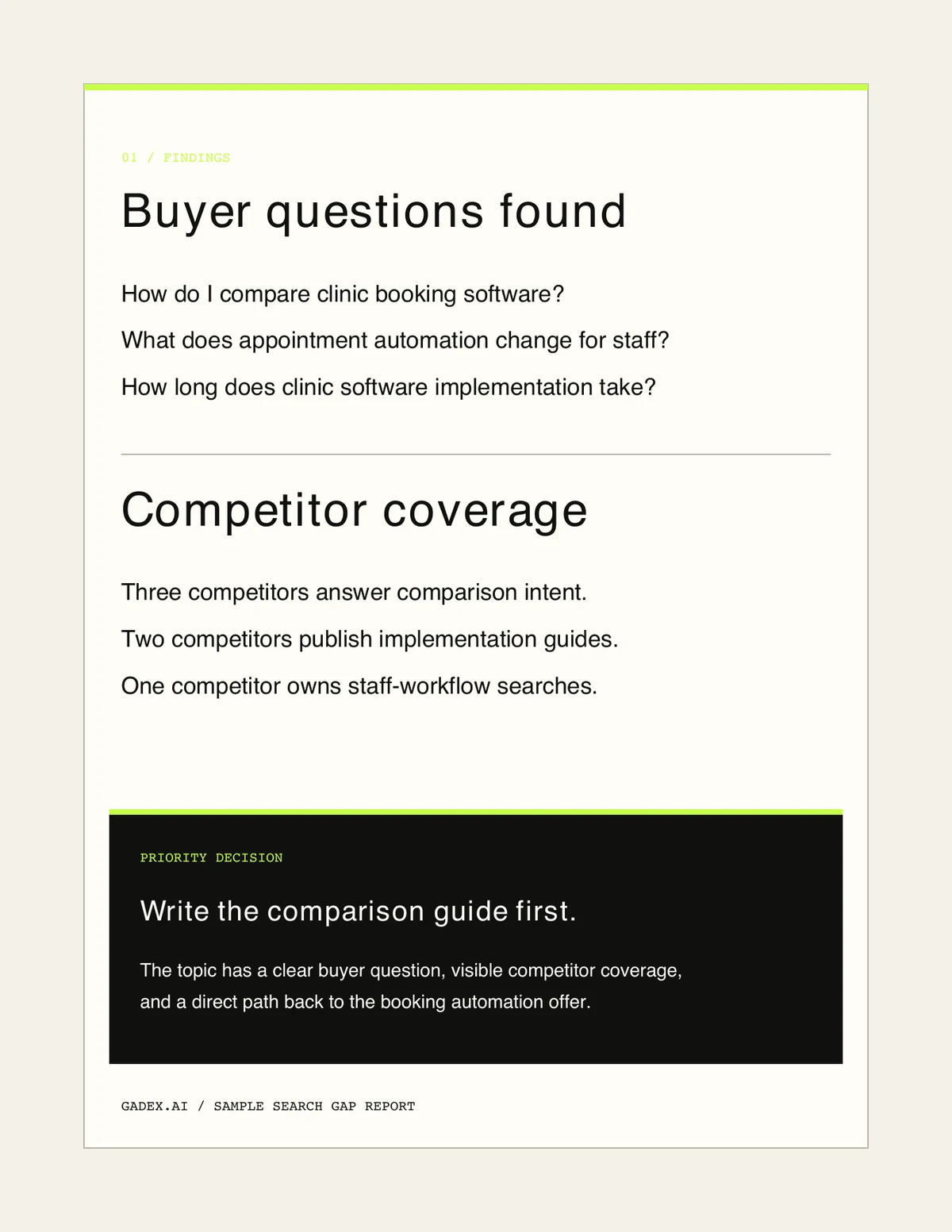
This sample uses a fictional clinic software site. The point is the structure: each finding explains the buyer question, the missing page, and the first page to produce.
Gadex sample report
Competitor Search Gap Report
- Site
- ClinicOS example
- Market
- Private clinics
- Scope
- Buyer questions and missing pages
Executive note
Competitors are winning searches around software comparison, appointment automation, and implementation risk. The site has product pages, but it does not answer the questions buyers ask before booking a demo.
01
Buyer questions found
- How do I compare clinic booking software?
- What does appointment automation change for staff?
- How long does clinic software implementation take?
02
Competitor coverage
- Three competitors answer comparison intent.
- Two competitors publish implementation guides.
- One competitor owns staff-workflow searches.
Priority decision
Write the comparison guide first.
The topic has a clear buyer question, visible competitor coverage, and a direct path back to the booking automation offer.
1Clinic booking software comparison guide
Answer vendor-selection intent and link to booking automation.
2Appointment automation workflow guide
Show how staff time, reminders, and patient intake change.
3Implementation timeline article
Reduce buying risk before sales conversations.
How this page is sourced
This page describes how Gadex works, written by Gadex. It is not a study and carries no dataset: statements about our own process are what we do, and statements about search or AI-answer behaviour follow the platforms’ current public documentation. Where something could not be supported, it is written as our view rather than as fact.
Search and answer engines change without notice, so check anything you are about to act on against the source. Our methodology sets out how pages are researched and reviewed, and our editorial standards set out what we will and will not claim — including how to tell us if something here is wrong.
Related pages